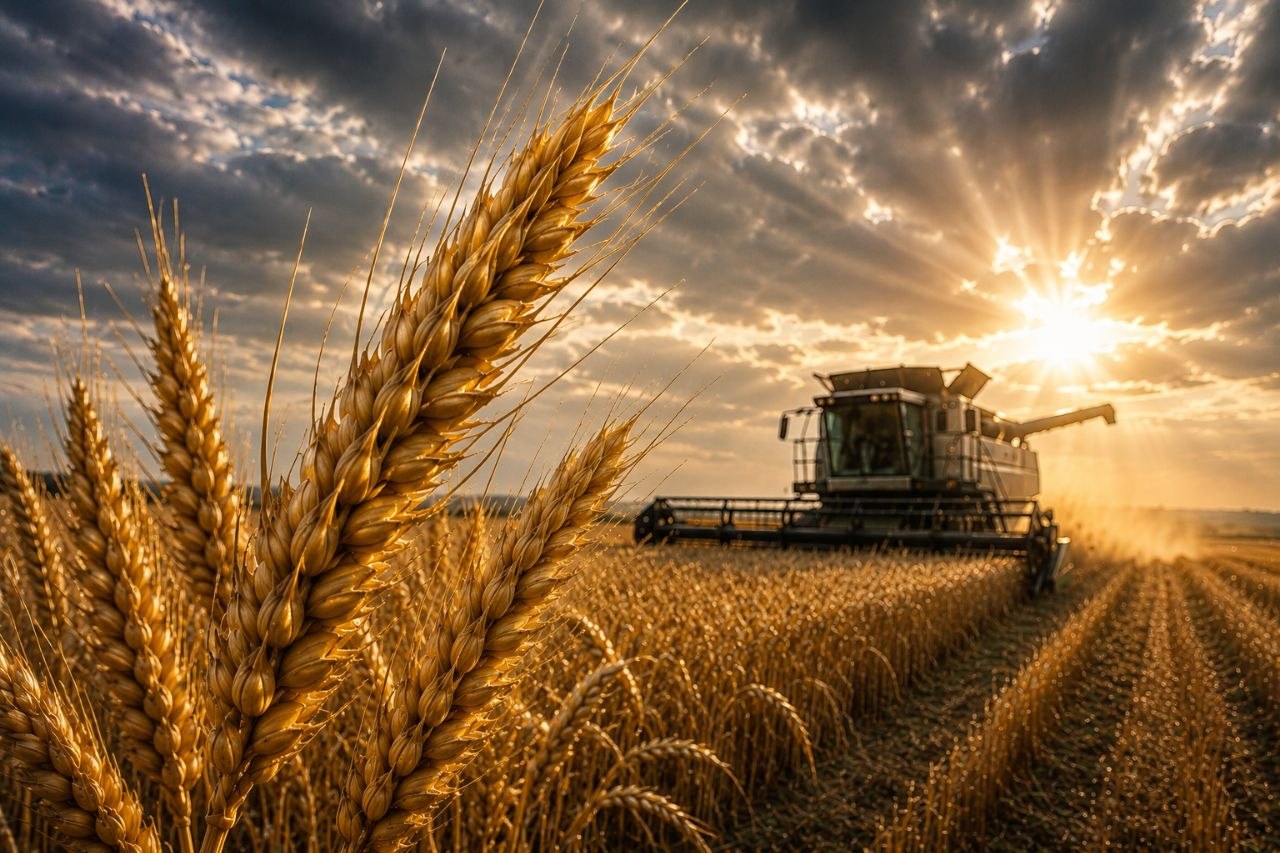
Over the past few years, Russian wheat has transformed from a regional agricultural product into a globally significant commodity. For companies operating in the grain trade, this creates new business opportunities. However, success depends on understanding the market: where the main trade flows go, which varieties are in demand, and where logistical bottlenecks arise.
The Global Wheat Market and Russia’s Position
Global wheat production remains at around 789 million tons annually. The market is valued at approximately $50–63 billion, and every percentage point of market share is worth hundreds of millions of dollars.
Russia has become the world’s leading wheat exporter. In the 2024/2025 marketing season, the country supplied around 42 million tons of wheat to global markets — approximately 21% of total world wheat exports. For comparison, Canada and the European Union each control around 13% of the market. By 2024, Russia’s total grain exports, including barley and corn, exceeded 71 million tons.
Russian grain is exported to more than 115 countries. The primary destinations are Africa and the Middle East, which account for about 78% of all Russian grain exports. Countries in these regions have become the largest buyers, importing approximately 8.6 million tons during the season.
However, the 2024/2025 season also revealed certain challenges. Wheat exports declined compared with the record-breaking 2023/2024 season, when exports reached 55.5 million tons. The main reasons included lower harvests caused by spring frosts and drought, as well as a stronger ruble. From July 1, 2024 through April, export shipment rates slowed significantly.
Elena Tyurina, Director of the Analytical Department of the Russian Grain Exporters and Producers Union, noted that shipment volumes in mid-April fell by more than half compared with the previous year. This marked the first such decline since the beginning of the 2022 season.
Competition is also intensifying. European producers are increasing supplies to Russia’s traditional markets. Nevertheless, Russia has maintained its leadership position. According to the Institute for Agricultural Market Studies, every fourth ton of wheat traded globally is of Russian origin.
Competitive Advantages of Russian Wheat
Russia possesses some of the world’s largest grain-growing areas, with approximately 29.8 million hectares allocated to wheat cultivation.
Russian producers grow both winter and spring wheat varieties.
- Winter wheat delivers higher yields and superior baking quality.
- Spring wheat, particularly durum varieties, is suitable for pasta production.
Russian third- and fourth-class wheat is widely used for food production. High protein content — often exceeding 12% — makes Russian flour well suited for bread and confectionery products.
Russian grain exports move through ports on the Black Sea, the Sea of Azov, the Caspian Sea, and the Baltic Sea. Supplies to Iran are transported via Astrakhan, shortening delivery routes. With comparable quality, Russian wheat is often cheaper than Canadian or Australian grain.
Yields in key regions continue to rise. In Krasnodar Krai, average winter wheat yields reach 67 centners per hectare.
There are, however, certain restrictions. China currently allows imports only of spring wheat and barley from Siberian regions. Winter wheat — which forms the basis of Russian exports through southern ports — is not yet approved for shipment to China.
Wheat Prices in Russia
Over the past decade, wheat prices in Russia have gone through several cycles:
- growth in 2015–2016;
- a sharp increase in 2021–2022;
- correction and stabilization during 2023–2025.
The main influencing factors included:
- export demand;
- the ruble exchange rate;
- harvest volumes;
- global grain prices.
Average Wheat Prices in Russia (RUB per ton)
| Year | Average Price |
| 2015 | 10,500 |
| 2016 | 11,800 |
| 2017 | 9,200 |
| 2018 | 10,400 |
| 2019 | 11,300 |
| 2020 | 13,500 |
| 2021 | 16,800 |
| 2022 | 18,500 |
| 2023 | 14,700 |
| 2024 | 15,500 |
| 2025 | 16,000 |
Sources: agricultural market statistics and historical price archives from agro-bursa.ru
Wheat Processing: From Flour to Finished Products
Flour is the primary processed wheat product.
Russia produces:
- premium-grade flour for confectionery;
- first-grade flour for baking;
- wholemeal flour.
Durum wheat flour contains approximately 12–14 grams of protein per 100 grams of product.
Bakery products are mainly produced from soft wheat varieties with strong gluten properties. Gluten creates the elastic structure in dough necessary for quality bread production. Domestic food consumption of grain crops in Russia totals around 40 million tons annually.
Pasta products are manufactured from durum wheat. Russia cultivates durum wheat primarily in Altai Krai, Orenburg Region, and Saratov Region. Exports of durum wheat are developing, although competition with Canada and the United States remains strong.
Feed-grade wheat is used for livestock nutrition. Barley is also widely utilized in the feed industry, with Russian barley exports reaching approximately 4.6 million tons in 2024.
Production Geography: Russia’s Key Wheat Regions
Rostov Region, Krasnodar Krai, and Stavropol Krai together produce more than one-third of all Russian wheat.
Major Producing Regions
- Rostov Region harvested approximately 10.1 million tons in 2024, accounting for 12.3% of the country’s total harvest.
- Krasnodar Krai ranked second with 9.9 million tons.
- Stavropol Krai produced around 6.5 million tons.
Proximity to the Novorossiysk port makes exports from these regions especially profitable.
Voronezh, Kursk, and Tambov regions are also among the top producers. Volgograd and Saratov regions cultivate wheat as well, although their climate is more arid.
Altai Krai is the leader in spring wheat production, while grain from the Far East is exported primarily to China.
The top five producing regions account for approximately 42% of Russia’s total wheat harvest.
Southern regions have a logistical advantage, as grain is shipped through ports in the Azov-Black Sea basin. Russia’s grain export capacity depends heavily on port infrastructure and throughput.
Largest Markets for Russian Wheat
Egypt
Egypt imported approximately 8.6 million tons of Russian wheat during the 2024/2025 season. The country purchases grain primarily for its state bread subsidy program.
Turkey
Turkey acquired around 3.5 million tons, roughly half the volume of the previous season due to temporary import restrictions.
Iran
Iran increased imports from 1.2 million tons to 1.5 million tons. Deliveries are mainly routed through Astrakhan.
African Markets
African demand continues to grow rapidly:
- Nigeria increased purchases to 1.53 million tons — nearly triple previous levels.
- Kenya imported 1.43 million tons.
- Israel raised imports from 1.2 million tons to 1.5 million tons.
Asian Markets
- Bangladesh imported 2.8 million tons.
- Vietnam increased purchases 2.8 times, reaching 550,000 tons.
China and the Asian Market: Potential and Limitations
In 2024, China imported approximately 345,800 tons of Russian wheat — a small share compared with China’s total wheat imports of 11.9 million tons.
China’s main suppliers remain:
- Canada;
- Australia;
- Kazakhstan.
Between January and September 2025, Russia exported only 17,700 tons of wheat to China — more than sixteen times lower than the previous year.
The reason is regulatory restrictions. China currently permits imports only of spring wheat and barley from Siberian regions. Winter wheat, which accounts for 80–85% of Russia’s harvest, is not allowed into the Chinese market.
Barley exports show stronger dynamics. During the 2023/2024 season, China imported 755,000 tons of Russian barley — a record volume.
Corn has become the fastest-growing category. In 2025, Russian corn exports to China tripled to $107.6 million, making Russia the third-largest corn supplier to China.
According to the head of Agroexport, Russian exports of grain and legumes to China increased eightfold over the past five years, reaching approximately $700 million in 2024.
If China eventually allows imports of Russian winter wheat, export volumes could rise by several million tons.
Vietnam and Indonesia are also steadily increasing purchases. Asia remains the market of the future, with enormous growth potential.
Opportunities for International Buyers and Investors
The Russian market offers several entry points for international businesses.
Direct Procurement
Purchasing directly from producers allows buyers to reduce margins but requires a strong understanding of logistics and local market conditions.
Trading Companies
Working with traders is often more convenient. These companies provide full-service solutions, from procurement to port loading. Contracts are usually signed under FOB or CFR terms.
Investments in Processing
Processing investments are attractive for long-term investors. Russia consumes around 40 million tons of grain annually for food purposes. The government offers subsidies for elevator construction and preferential financing programs.
Logistics Projects
Investment opportunities also exist in:
- port terminals;
- transshipment complexes;
- seasonal financing operations.
Currency volatility and sanctions-related restrictions create certain risks, but these risks can be managed through properly structured contracts.
Russia continues expanding into new markets:
- Mexico approved phytosanitary certification forms for Russian grain;
- India approved lentil imports;
- the total number of importing countries has reached 172.
Future Prospects for Russian Wheat Exports
Analysts forecast grain production growth to 132.4 million tons in the 2025/2026 season, compared with 124 million tons previously.
Wheat production alone may reach 84.6 million tons.
At the same time, European countries are increasing production. Romania, for example, expects a harvest of 12.5 million tons, up from 10.1 million tons.
Export prices are also expected to recover gradually. Elena Tyurina noted that the upward trend began in December 2024.
From February 15 to June 30, 2026, Russia introduced an export quota of 10.6 million tons, limiting shipments during the second half of the season.
Meanwhile, Russia resumed exports to Nigeria, Morocco, and Indonesia with record shipment volumes.
If restrictions on winter wheat exports to China are lifted, Russian exports could increase by several million tons.
The Russian government plans to increase grain exports to 75 million tons by 2030.
Exports of chickpeas, buckwheat, and lentils are also growing. Development of value-added processing industries could significantly increase export revenues even without expanding physical volumes.
Final Outlook
By the end of 2025, Russia retained its position as the world’s largest wheat exporter, supplying approximately 41 million tons to international markets.
Every fifth ton of wheat traded globally is of Russian origin.
Although export volumes declined slightly compared with the previous season, Russia’s export potential has increased several times over compared with the 2010s.
For international buyers, Russian wheat remains an attractive option:
- stable supply volumes;
- a wide variety of grades and classes;
- competitive pricing.
For investors, the sector offers numerous opportunities, from direct investments to logistics and infrastructure projects.
The future of Russian wheat exports will depend on harvests, global prices, and infrastructure development. However, the fundamentals remain strong:
- vast areas of fertile land;
- experienced agricultural producers;
- growing global demand.
Russia is expected to remain one of the key players in the global grain market for many years to come.
Where to Buy Russian Wheat Wholesale?
To purchase Russian wheat wholesale, contact the G2R platform and submit a request through the relevant product category page.
A platform manager will contact you shortly to discuss the details.
The G2R team will then help select a supplier in Russia according to your requirements and assist with organizing logistics and delivery.
You will only need to receive the goods in your city.
Please note that the G2R platform itself is not a direct seller of products. It acts solely as a facilitator for finding suppliers in Russia and organizing the supply process.