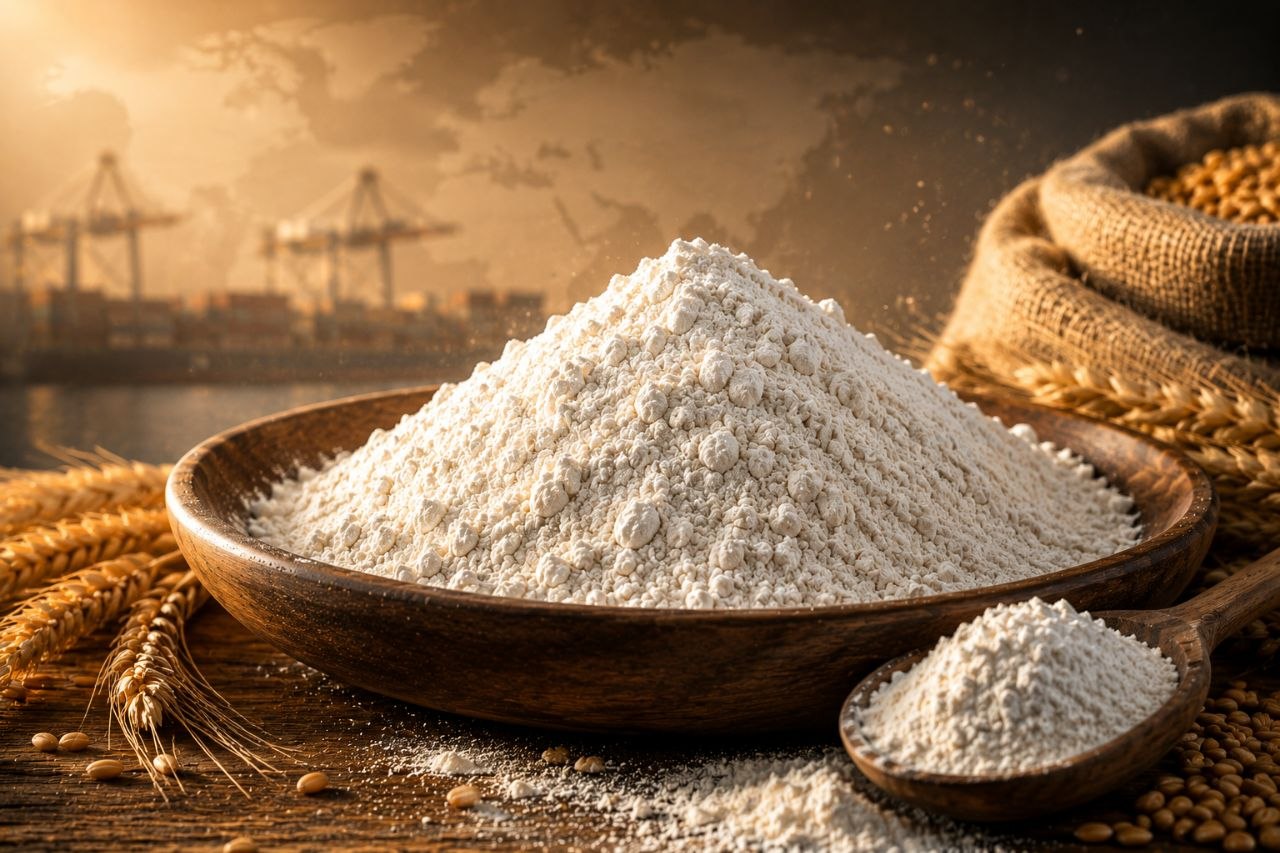
Over the past few years, Russia’s flour milling sector has experienced an export boom. Shipments have increased fivefold, while export geography has expanded from Afghanistan to Thailand.
The Global Wheat Flour Market and Russia’s Position
Global wheat flour production remains at around 380 million tons annually. Just a few years ago, Russia exported roughly 300,000 tons of flour per year. By 2024, however, Russian flour exports had reached almost $300 million, or more than 1.15 million tons. Growth over three years amounted to nearly 400%.
What changed? In 2021, the Russian government introduced high export duties on raw grain. This made it more profitable for processors to export flour instead. Flour mills gained a strong incentive to look for buyers abroad.
Today, Russian flour is supplied to more than 60 countries. In 2024, Afghanistan became the largest importer, purchasing $80 million worth of Russian flour, followed by China and Turkmenistan. Agroexport estimates that export revenue could exceed $440 million by 2030.
The path, however, has not been entirely smooth. In 2025, export dynamics were uneven: some destinations declined, while others continued to grow steadily. Still, the first quarter of 2026 brought encouraging signs that growth momentum was recovering.
Competitive Advantages of Russian Wheat Flour
A Raw Material Base Without Equal
In 2022, Russia harvested a record wheat crop of 104.2 million tons. In 2023, the harvest reached 92.8 million tons. In 2025, wheat exports amounted to 41 million tons, allowing Russia to maintain its position as the world’s largest wheat exporter.
Domestic consumption remains stable at around 22–23 million tons per year. The remaining volumes are either exported as grain or processed into flour.
Quality That Buyers Value
Russian wheat, especially from Siberia and the Volga region, is known for its high gluten content. Producers offer a wide product range: from premium-grade flour to specialized types for noodles, bakery products, steamed buns, and other applications.
Prices Below Competitors
Russian flour is approximately 20% cheaper than comparable products from competing suppliers. In December 2025, producer prices were 3–8% lower than in December 2024. For large importers, this is a significant cost-saving factor.
Modern Technologies
In recent years, investment has entered the sector. Major agricultural holdings have launched new production facilities or upgraded existing ones. Modern equipment makes it possible to produce flour with stable specifications.
In 2023, profitability in flour production reached 7.78%, a record level. Logistics, however, remains a bottleneck. Flour requires special packaging, and transportation costs absorb part of the margin.
Applications and Products Made from Wheat Flour
The bakery industry accounts for the largest share of flour consumption. Bread production uses different types of flour, and quality depends directly on gluten — the protein complex that forms an elastic network in dough.
The pasta industry requires special flour made from durum wheat. Russia produces semolina and semi-semolina suitable for high-quality spaghetti and vermicelli.
The confectionery industry uses flour with low gluten content to achieve a delicate texture.
Dumpling production requires elastic dough. Asian foods such as noodles, baozi, and mantou also require specialized flour types.
A notable trend is functional flour enriched with vitamins and protein. This is a promising niche with growing demand.
Flour Quality: How the Product Is Evaluated, Why Prices Differ, and Where the Risks Are
Flour is one of the most standardized products in agricultural processing, yet differences between batches can be substantial. For professional buyers, the grade alone is not enough. Dozens of technical parameters matter: protein content, gluten quality, ash content, moisture, falling number, and milling stability.
These indicators determine how the dough behaves, what the final bread will look like, how long the product can be stored, and how safe the raw material is.
In Russia, flour is produced either according to GOST standards or TU — technical specifications set by the manufacturer.
GOST is a national standard that strictly regulates product quality. For wheat bread flour, the applicable standard is GOST 26574-2017; for rye flour, GOST 7045-2017; and for pasta flour, GOST 31463-2012. These standards define requirements for moisture, whiteness, gluten, ash content, and other characteristics.
The main advantage of GOST is stability. Buyers understand what parameters they will receive regardless of the producer. This is why GOST flour is often preferred by large bakeries, exporters, and international buyers.
TU is a more flexible format. The producer independently defines product characteristics for specific purposes: confectionery, noodle production, the budget segment, or specialized flour blends.
Key Flour Quality Parameters
Gluten
Gluten is the key indicator for the bakery industry. It determines dough elasticity, gas retention, and crumb structure.
Lower-quality flour usually contains around 18–22% gluten. Medium-quality flour contains 23–27%. High-quality flour contains 28% or more.
The higher and more stable the indicator, the more expensive the product. Strong flour is especially valued in industrial baking because it ensures consistent results and a high yield of finished products.
However, this is also where one of the main market risks appears. Some producers artificially increase the indicator by adding dry gluten or blending different batches. On paper, the figures may look excellent, but in production the dough can prove unstable.
Protein
High protein content directly affects both nutritional value and technological performance. A low level is 9–10%, medium is 11–12%, and high is 13–15%.
High-protein flour is in demand for premium baking, sports nutrition, and specialized products. Such flour is always more expensive.
However, there is an important nuance: high protein does not automatically guarantee good dough quality. Sometimes flour shows excellent laboratory numbers but has weak gluten structure. As a result, the dough loses shape and performs poorly in production.
Ash Content
Ash content indicates how much of the grain shell has entered the flour. The lower the figure, the whiter and “cleaner” the flour.
For premium grade flour, ash content is usually around 0.55%; for first grade, around 0.75%; and for second grade, it can exceed 1%.
Low ash content is especially valued in premium bakery products, confectionery, and noodles. Such flour costs more. Higher ash content is typical for wholegrain and rye products.
However, excessively white flour can be a warning sign. In some cases, producers use aggressive cleaning or bleaching, which reduces the product’s nutritional value.
Moisture
Normal flour moisture should not exceed 15%. High moisture is dangerous for several reasons:
- shelf life is reduced;
- mold risk increases;
- the probability of mycotoxin development rises.
Moisture also directly affects the weight of the batch. Some unscrupulous suppliers artificially increase moisture content, effectively selling water instead of dry product.
For exports and long-distance logistics, this parameter is especially critical.
Falling Number
The falling number reflects enzyme activity in grain and flour. The normal range is 220–300 seconds.
If the figure is too low, the dough becomes sticky, bread bakes poorly, and crumb structure deteriorates.
This parameter is strongly affected by weather conditions. After a rainy season, enzyme activity in grain can change sharply, creating risks for the milling industry.
For large bakeries, the falling number is one of the mandatory control parameters.
Whiteness
Whiteness is especially important for Asian countries and the Middle East, where product appearance matters greatly.
White flour is used in:
- noodle production;
- premium bakery products;
- confectionery.
However, excessive whiteness may indicate over-refining, during which some beneficial nutrients are lost.
Why One Flour Costs More Than Another
Price is shaped by several factors. First comes the quality of the grain. Then buyers consider:
- protein content;
- gluten strength;
- batch stability;
- milling precision;
- producer reputation.
Large producers usually sell at higher prices, but they ensure repeatable quality — a crucial factor for industrial processing.
Premium flour can cost 30–70% more than standard flour precisely because of parameter stability.
Main Risks When Buying Flour
Quality Substitution
One of the most common risks is when the laboratory sample does not match the actual shipment.
This is why international buyers often use independent inspection companies such as SGS, Bureau Veritas, and others to verify quality before shipment.
Batch Instability
Even one producer can have significant differences between batches. This happens especially often:
- when flour is produced according to TU;
- when grain of different quality is used.
For industrial production, such instability is critical.
Mycotoxins and Safety
If grain is stored improperly or moisture is too high, mycotoxins may develop. These are dangerous fungal compounds. Safety requirements are especially strict for baby food and exports.
Adulteration and Improvers
The market may include cases of adding bleaching agents, improvers, dry gluten, or enzyme preparations. Some of these additives may be technologically permitted, but the buyer must clearly understand what is included in the product.
For flour exports, the following documents and indicators are important:
- laboratory report;
- phytosanitary certificate;
- safety declaration;
- protein indicators;
- gluten indicators;
- moisture indicators;
- falling number;
- mycotoxin analysis;
- non-GMO confirmation.
For China and Middle Eastern countries, whiteness, quality stability, and absence of foreign odor are particularly important.
Production Geography in Russia
The Central Federal District ranks first, accounting for around 35% of production. Its main advantage is proximity to key consumers.
The Siberian Federal District ranks second, with around 20%. Altai Krai produces high-quality flour from local wheat with high gluten content. Siberian producers are actively developing exports to Mongolia, Kazakhstan, and China.
The Volga Federal District accounts for around 18% of production. Southern regions are also expanding capacity, producing pasta flour from durum wheat.
New plants are equipped with world-class machinery, while older enterprises operate at 60–70% capacity utilization.
Main Importers of Russian Wheat Flour
Afghanistan is the clear leader. In 2024, it purchased $80 million worth of flour, twice as much as the year before. The country faces a serious shortage of domestic grain.
China shows mixed dynamics. In 2024, China ranked second among importers, but in 2025 the total value of shipments fell to $20.3 million, compared with $29.9 million in 2024. Russia ranked second after Japan, which supplied $43.2 million.
However, the first quarter of 2026 showed a sharp reversal. From January to March 2026, exports to China increased 2.4 times, reaching 45,000 tons compared with 18,000 tons a year earlier. China’s share in Russian flour exports reached 38%. Russia supplied 53% of China’s imported flour needs.
Turkmenistan ranks third among stable buyers. Middle Eastern countries are increasing purchases: Iraq expanded imports several times, while shipments to Iran grew 18-fold.
CIS countries maintain stable demand. Shipments to Kazakhstan and Uzbekistan increased 1.6 times, while exports to Mongolia grew sixfold.
Promising markets include Southeast Asia, Africa, and Latin America.
China as a Strategic Market for Russian Flour
The Chinese market is the most dynamic destination for Russian flour exports. In 2023, China imported 217,800 tons of wheat flour. Russia supplied 143,000 tons — almost two thirds of total imports.
China produces around 100 million tons of flour annually. In the northern provinces, flour-based products form the basis of the diet.
Consumption traditions shape demand. China has more than 1,200 types of noodles. Baozi are steamed buns, mantou is steamed bread, and jiaozi are dumplings. Each product requires its own type of flour. Russian producers are developing specialized varieties for these needs.
The growing middle class is demanding premium products: flour with higher protein content and vitamin enrichment. Packaging also matters: large formats for industry, smaller packaging for the premium segment.
To export to China, registration in the CIFER system is required. Each shipment must comply with GB standards. Russian companies have obtained these approvals.
However, China imports wheat flour under the wheat tariff-rate quota, one of the strictest market protection measures in China.
The import quota for wheat and flour is unified for all supplier countries, including Russia, and does not provide separate preferences.
Key import quota parameters for 2026:
- quota size: 9.6 million tons for wheat, including flour;
- validity period: January 1 – December 31, 2026;
- status: approved and maintained at the 2025 level;
- duty within quota: 1%;
- duty outside quota: 65%;
- quota distribution: 90%, or 8.64 million tons, through state trading.
To receive a quota, the importer must submit an annual application to China’s National Development and Reform Commission, or NDRC. Preference is given to companies with import experience and large processors with capacity of at least 200,000 tons of grain per year.
Since January 1, 2022, all foreign food producers, including flour mills, must complete online registration with China’s General Administration of Customs, or GAC, and obtain a unique registration number to be indicated on packaging.
The variable dynamics of recent years show that the Chinese market is sensitive to external factors. Lower shipment margins and stronger competition in other markets affected volumes in 2025. However, the sharp growth in early 2026 — with China’s share rising from 14% to 38% in just one quarter — demonstrates a recovery in demand.
Agroexport estimates the potential of the Chinese market at 200,000–250,000 tons by 2030, worth up to $100 million.
Opportunities for International Buyers and Investors
Available Capacity
Many mills operate at only 60–70% capacity. Production can be increased quickly without building new lines.
Contract Manufacturing
Buyers can order flour under their own private label. The producer provides quality, packaging, and documentation.
Preferential Duties Encourage Processing
Selling flour is more profitable than selling grain. Russian flour is around 20% cheaper than comparable products, and lower producer prices at the end of 2025 strengthened this advantage.
Technical Support
Russian producers advise buyers on application, select the optimal flour type, and support production technology.
Investment Opportunities
Profitability reached 7.78%. Payback periods for modernization projects are usually 3–5 years.
Market Outlook Through 2030
Export growth is expected to continue. Potential revenue may exceed $440 million by 2030. The domestic market is stable, so further growth is possible mainly through exports.
China remains a key destination despite volatility. The sharp increase in early 2026 — 2.4 times in one quarter — shows that Russian companies can expand their share with the right strategy. The middle class is growing, and urbanization continues.
Geographic diversification is essential. Dependence on one or two markets revealed its risks in 2025. Russian companies are developing Southeast Asia, Africa, and the Middle East.
Premiumization and functional flour are the future of the industry: flour for athletes, vitamin-enriched flour, and gluten-free products. Margins are higher and competition is lower.
Government support is expected to strengthen through preferential loans, subsidies for modernization, and compensation of transport costs.
Thus, Russian wheat flour has moved from being a local product to a significant export category in just three to four years. Exports have grown fivefold, and geography has expanded to 60 countries.
Recent dynamics show that the market is volatile but promising. The decline in 2025 was followed by sharp growth in early 2026. This confirms that demand exists — but strategy must remain flexible.
Opportunities for international buyers and investors are real: available capacity, competitive prices, and improving quality. China, CIS countries, the Middle East, and Africa are open markets.
Where to Buy Russian Wheat Flour Wholesale?
To purchase Russian wheat flour wholesale, contact the G2R platform and submit a deal request through the relevant product category card. A platform manager will contact you shortly to clarify the details.
After that, the G2R team will select a Russian supplier according to your requirements and help organize the delivery. You will only need to receive the goods in your city.