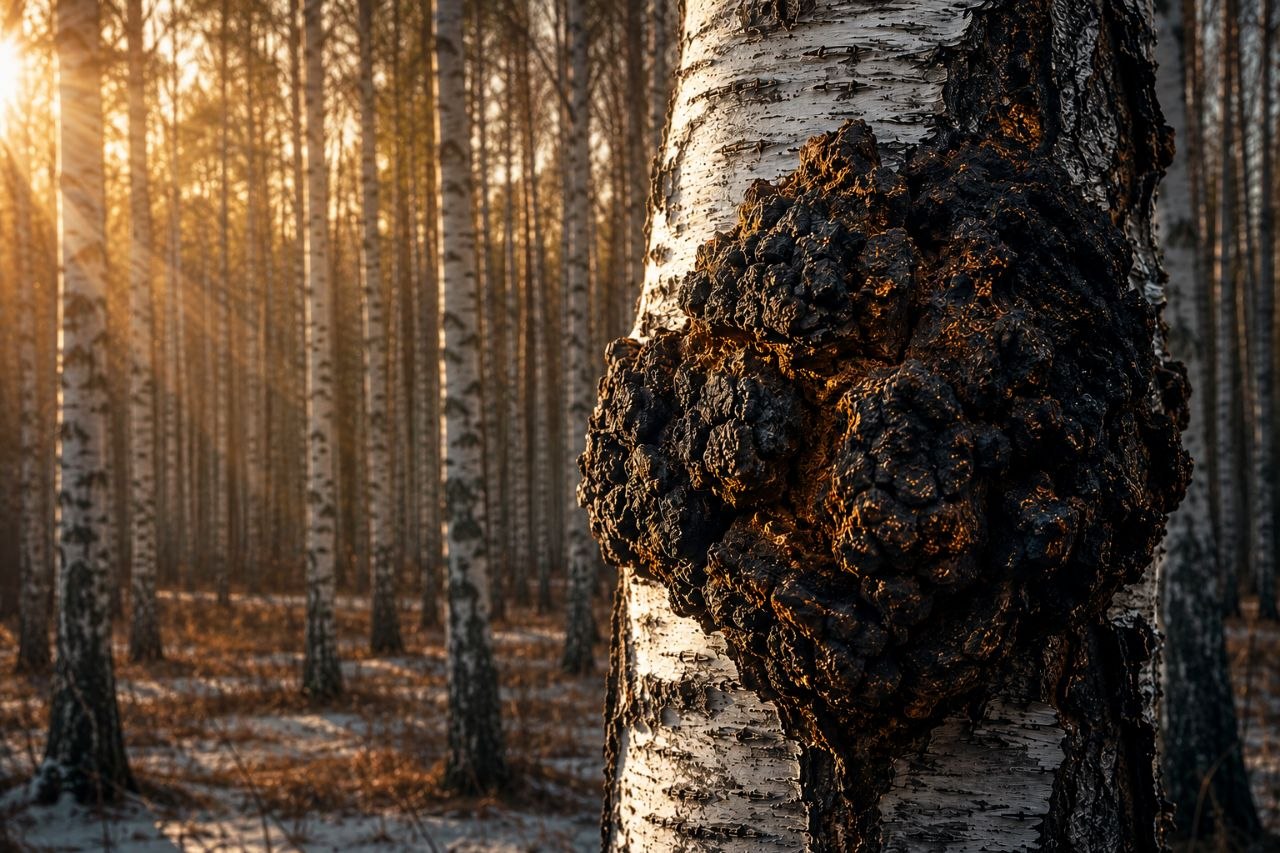
Chaga, also known as birch mushroom, is one of Russia’s most promising non-timber forest resources in terms of export potential. Thanks to its unique beneficial properties and the high concentration of global reserves located specifically within the Russian Federation, the product is experiencing growing international demand.
Chaga grows under specific climatic conditions. It develops only on birch trees in cold regions where temperatures fall below -34°C for more than two to three months per year.
Where Chaga Grows in Russia
Chaga grows primarily on living birch trees, which means its habitat coincides with the distribution of birch forests. In Russia, the main harvesting areas include Siberia, the Far East, the Urals, central Russia, and the northern regions of the European part of the country.
Chaga is mainly found in Primorsky Krai, Zabaykalsky Krai, Krasnoyarsk Krai, the Omsk, Tomsk, Vologda, and Kirov regions, the Republic of Mari El, Udmurtia, Tuva, Altai Krai, and the Komi Republic.
According to experts, more than 90% of the world’s chaga reserves are concentrated in Russia, making the country one of the largest raw material bases in the world. Industrial-scale processing of chaga into extract is carried out in several regions.
The largest production facilities are located in Altai Krai and Perm Krai. It should be noted that a significant portion of Russian production is still focused on exporting raw materials (dried mushrooms) rather than finished extracts, leaving considerable potential for the development of deep processing within the country. This sector may become especially attractive for foreign investors, as the niche demonstrates strong growth prospects supported by export volume analytics.
Export Geography: Main Supply Destinations
The geography of Russian chaga exports has expanded significantly in recent years. Key destinations include countries in the Asia-Pacific region, primarily China, Vietnam, the Republic of Korea, and Japan.
By the end of 2020, the main recipients of chaga from the Kirov region were China (487 tons), South Korea (91.3 tons), Latvia (86.9 tons), Kazakhstan (2.2 tons), Mongolia (1 ton), and Belarus (0.5 tons). In 2025, Vietnam emerged as a leading destination: from January to December alone, 205 tons of chaga were shipped there from the Vologda region, while the total volume of exports from Vologda to Vietnam exceeded 158 tons during 2025. In addition, products harvested in the Republic of Tuva, Tomsk Region, Primorsky Krai, and Udmurtia were exported to China, Vietnam, and Japan.
Nevertheless, China remains the largest and most stable buyer of Russian chaga. In 2020 alone, 487 tons of the mushroom were exported to China from the Kirov region, while total Russian exports to China were estimated at approximately 1,283 tons (2019 data, though the trend continued into 2020).
In 2025, export volumes to China continued to rise. According to the Primorsky Interregional Directorate of Rosselkhoznadzor, during the first 10 months of 2025, 666.6 tons of chaga were certified for export to China, Vietnam, and Japan. A significant portion of this volume was destined for China. It is also important to note that Primorsky Krai increased its chaga exports by 7.8 times compared to the same period in 2024 (85.5 tons), indicating explosive demand growth.
Opportunities for Foreign Investors
In 2025, Russia adopted regulatory acts that significantly simplify the investment process. Presidential Decree No. 436 “On Additional Guarantees of the Rights of Foreign Investors,” signed on July 1, 2025, established a special legal framework allowing foreign partners to invest in Russia.
To facilitate investment activities, special accounts are provided through which funds in both rubles and foreign currencies can be freely transferred into and out of Russia. These measures create a transparent and predictable mechanism for international investment in Russian business.
In addition, Russian tax legislation offers foreign investors several significant preferences. Starting January 1, 2025, the Federal Investment Tax Deduction (FITD) came into force, allowing companies to reduce the federal portion of profit tax by 5% provided profits are reinvested into production development. This is especially relevant for deep chaga processing projects requiring significant investments in equipment and technology.
Particular attention should be paid to new spatial development instruments — International Priority Development Territories (IPDTs), which will begin operating in 2026. This mechanism was specifically designed to attract large foreign investments to the Russian Far East. IPDT residents receive substantial benefits, including a zero profit tax rate for 10 years, reduced insurance contributions of 7.6% for the same period, as well as guarantees of stable tax and legal conditions for 15 years.
Five such territories will be established in key Far Eastern regions — Amur Region, Primorsky Krai, Zabaykalsky Krai, Khabarovsk Krai, and the Jewish Autonomous Region. To obtain resident status, the investment volume must be at least 500 million rubles. These conditions are ideal for creating large processing facilities and logistics centers focused on exporting chaga products to Asia-Pacific countries.
In addition to general economic incentives, investors in chaga processing may also qualify for specialized government support. In 2025–2026, Russia continues to operate subsidy programs supporting the harvesting and processing of wild plants and mushrooms. These funds may be directed toward purchasing specialized equipment for storage and processing.
Export Potential and Global Demand
Global market analytics confirm the enormous potential of chaga products. According to various research agencies, the global chaga mushroom market is expected to reach USD 2.10 billion by 2032, demonstrating an average annual growth rate of 7.94%. At the same time, the chaga extract market — the most technologically advanced and high-value segment — is projected to grow even faster, from USD 488.2 million in 2025 to USD 1.5 billion by 2035, with an average annual growth rate of 11.8%.
The Asia-Pacific region is the key driver of this growth, where the chaga mushroom market is projected to grow at the fastest rate globally — 11.69% annually from 2025 to 2032. This is driven by rapid urbanization, rising disposable incomes, and increasing popularity of traditional medicinal mushrooms in China, Japan, and India.
The food and beverage segment appears especially promising, as chaga extract is increasingly used as a functional ingredient. Technological advances in extraction methods, such as supercritical CO2 extraction and solvent-free processing, improve the quality and purity of chaga extracts, increasing consumer trust and expanding applications in cosmetics and nutraceuticals.
Health Benefits of Chaga for Humans
Why is chaga extract experiencing such rapidly growing demand on international markets? The product’s popularity is driven by its beneficial properties. Chaga is valued for its unique biochemical composition. The mushroom grows primarily on birch trees and appears as a black or dark brown growth. Its thin thread-like hyphae penetrate the wood, extracting nutrients and sap.
Chaga has traditionally been used as a general tonic beverage, especially during periods of increased stress, seasonal colds, and recovery after illness. The mushroom is also used as a mild digestive support remedy.
As noted by Roskachestvo expert Elena Syurakshina — an endocrinologist of the highest category, Candidate of Medical Sciences, and nutritionist — chaga contains such beneficial compounds as:
- Betulin — a triterpene with anti-inflammatory and antioxidant properties that may also help lower cholesterol levels.
- Polyphenols — compounds known for their antioxidant activity, helping protect cells from oxidative stress.
- Beta-glucans — polysaccharides that may strengthen the immune system and support cardiovascular health.
- Tannins — compounds with antiseptic and anti-inflammatory properties.
- Amino acids — essential for protein synthesis in the body.
Key components of the product also include chromogenic polyphenol-carboxylic complexes, melanins, polysaccharides, organic acids, sterols, and trace elements.
Main Scientifically Confirmed Beneficial Properties
- Antioxidant activity: water extract of chaga demonstrates high antioxidant activity in a number of studies. It slows oxidative stress, reduces DNA fragmentation, and decreases cellular damage accumulation by 40%.
- Potential antitumor activity: chaga melanins are being studied for potential antitumor effects and the enhancement of chemotherapy efficacy.
- Immunomodulatory and antiviral properties: laboratory studies have identified potential antiviral activity against hepatitis C and herpes simplex virus type 1 at concentrations of 0.2–3 mg/ml.
- Anti-inflammatory and detoxifying effects
- Digestive support: helps normalize intestinal microflora and is used in chronic gastritis and peptic ulcer disease.
- Cardiovascular support: helps reduce “bad” cholesterol and increase “good” cholesterol.
- General tonic and analgesic effects
“The main advantage of chaga is its high content of biologically active and antioxidant substances: polyphenols, pigments, organic acids, and enzymes. The best-known among them are betulinic and humic-like chaga acids. Supporters of traditional medicine claim these substances can destroy cancer cells. However, science has not confirmed this fact, therefore chaga is used in oncology treatment exclusively as a supportive remedy,” explains Alexandra Yakovleva, gastroenterologist, therapist, and hepatologist from Saint Petersburg.
The combination of beneficial properties explains the strong global demand for Russian chaga extract from pharmaceutical, cosmetic, and food companies worldwide.
Pharmaceutical companies use chaga in the production of medicines and dietary supplements. In the beauty industry, chaga extract is used in anti-aging creams and masks, detox masks for oily and problematic skin, as well as protective and restorative balms that create a natural skin barrier and soothe stressed skin.
In the food industry, chaga is used to produce traditional teas, additives for dairy products, confectionery, sports nutrition, and dietary foods. Some Russian manufacturers have even begun producing craft beer and candies with added chaga.
“Chaga helps regulate the endocrine and immune systems by accelerating metabolism. It also has anti-inflammatory and antitumor effects, removes toxins from the body, enhances bile flow, and prevents stagnation. Birch mushroom positively affects overall health: it normalizes cholesterol levels, supports healthy blood pressure, improves overall performance, acts on the pineal gland, and promotes melatonin production, which helps normalize sleep,” says Alexey Zhito, therapist, endocrinologist, cardiologist, and Candidate of Medical Sciences.
How to Properly Consume Chaga
If you purchase a ready-made product, it is best to follow the manufacturer’s instructions for use. Chaga is often recommended to be brewed in glass or enamel cookware using a ratio of 50 g per 500 ml of boiled water at a temperature not exceeding 50°C. The infusion should then steep at room temperature for approximately two days. Afterward, it should be strained, squeezed, and diluted with boiled water back to 500 ml. Shake before consumption. The course of use should be discussed with a healthcare professional.
Doctor Alexey Zhito recommends consuming chaga according to the following schedule: one month of use followed by one month of break. This helps avoid potential negative effects.
If using natural powdered chaga, one teaspoon should be brewed in a cup of boiling water, steeped for 5 minutes, strained, and consumed like regular tea.
If chaga is in chunks, it should be boiled. Boiling time may range from 15 minutes to 3 hours depending on the quantity and size of the mushroom pieces. The longer it is boiled, the richer and stronger the beverage becomes.
Whole mushrooms are recommended to be chopped into pieces and brewed in a thermos using a 1:5 ratio.
RBC experts note that chaga tea has a woody flavor and a light brown color.
“Chaga should be used cautiously by pregnant and breastfeeding women, people with blood clotting disorders, and those taking anticoagulants. Of course, birch mushroom may also be harmful for individuals allergic to birch.
A doctor’s consultation is necessary before using chaga because this ingredient may interact with certain antibiotics and contribute to kidney stone formation,” says Alexey Zhito.
Where to Buy Russian Chaga Extract Wholesale?
To do this, contact the G2R platform and submit a trade request through the relevant product category page. A platform manager will contact you shortly to clarify the details.
The G2R team will then select a supplier in Russia according to your requirements and help organize procurement and delivery. All that remains is for you to receive the product in your city.
The information provided in this article is for informational purposes only and does not constitute medical advice. Chaga products are not intended for the diagnosis, treatment, or prevention of diseases. Consultation with a healthcare professional is recommended before use.