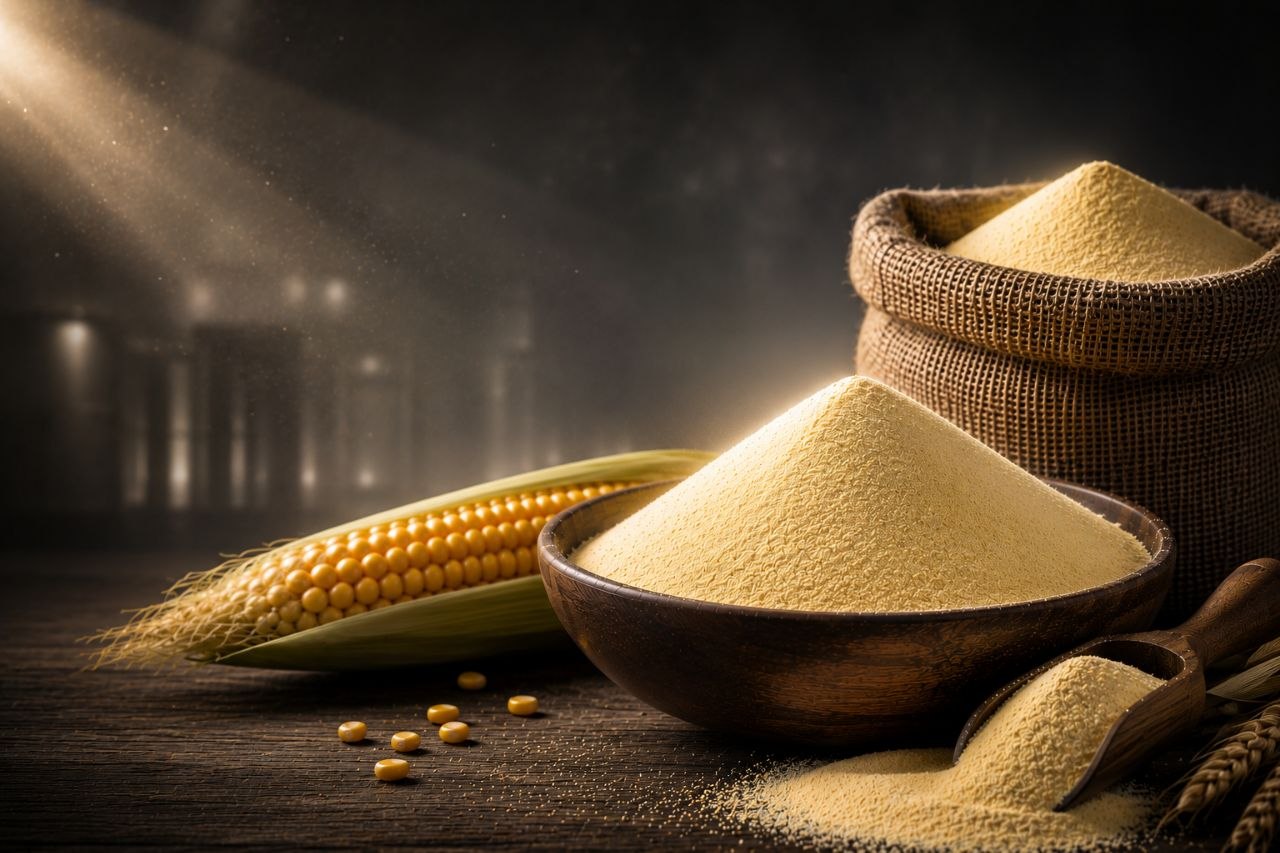
The Russian corn flour market is currently going through a period of transformation and growth. Producers are adapting to changes in currency markets, launching new processing facilities, and expanding into promising export destinations. For international buyers seeking a reliable supplier of high-quality corn flour, Russia remains an attractive partner. Let us take a closer look at the current state of the industry and the opportunities available to importers.
Russian Corn Flour: What the Market Offers International Buyers
In 2024, Russian enterprises produced approximately 37 thousand tons of corn flour, marking a 3.6% year-on-year increase.
Corn flour occupies a niche segment within the global flour market, accounting for roughly 2.4% of total worldwide flour production. However, this niche is developing rapidly. Demand is growing due to global trends toward healthy eating, gluten-free products, and specialized dietary nutrition.
Russian manufacturers offer corn flour in various grinding grades — from coarse to ultra-fine milling. Each type serves a specific market segment:
- coarse milling for breading mixes and dietary products;
- medium milling for feed mixtures;
- fine milling for bakery products and baby food.
The Russian flour export market underwent significant restructuring in 2025. Total exports of all flour types declined to approximately 520 thousand tons compared to the record 1.19 million tons in 2024. The main reasons were the strengthening of the ruble and reduced export duties on wheat, which made raw grain exports more profitable than selling processed flour.
However, the situation began to improve in early 2026. Russian exporters are actively redirecting supplies toward new markets, increasing their presence in China and across Asia.
Advantages of Russian Corn Flour for Importers
Russian corn flour offers several important advantages for international buyers.
Strong Raw Material Base
Russia ranks among the world’s top ten corn producers. Gross harvest volumes exceed 16 million tons annually, while average yields reach a record 6.93 tons per hectare.
High Grain Quality
Southern Russian regions — Krasnodar Territory, Stavropol Territory, and Rostov Region — benefit from highly favorable agricultural and climatic conditions for corn cultivation. Producers use specialized grain hybrids with elevated starch content, resulting in flour with superior consumer properties.
Competitive Pricing
With comparable quality, Russian products remain competitively priced. For wholesale buyers, this is a major advantage, especially amid volatile global commodity prices.
Flexible Supply Conditions
Manufacturers are ready to work with different packaging formats — from industrial sacks to retail packaging. Products can also be adapted to the specific requirements of individual markets.
Applications of Corn Flour: From Food Production to Industry
Corn flour is a highly versatile product used across multiple industries.
Food Industry Applications
- Bakery production (as an additive to wheat flour or as a base for gluten-free bread)
- Confectionery products (cookies, muffins, cakes)
- Baby food (porridge and milk formulas)
- Snacks and chips
- Breading mixes
Traditional Cuisine
- Italian polenta
- Moldovan mamaliga
- Mexican tortillas
- Georgian mchadi
Industrial Applications
- Animal feed additives
- Starch production
- Brewing industry
- Sausage manufacturing
A particularly important growth area is the gluten-free food segment. Corn flour contains no gluten — a protein that causes intolerance in part of the population. For manufacturers of dietary products, this represents a key competitive advantage.
Where Corn Flour Is Produced in Russia
The Southern Federal District is the undisputed leader, accounting for 64.6% of all corn flour produced in Russia. The concentration of mills and factories is easily explained: the majority of the country’s corn is cultivated there.
Krasnodar Territory
Krasnodar remains the leading processing region. Several enterprises specialize in corn flour and corn grits production. Modern facilities equipped with fractionation technologies allow manufacturers to produce multiple flour grades on a single production line.
Stavropol Territory
Another major production center. In 2024, total flour production in the region increased by 6%, reaching 374 thousand tons. Corn flour accounts for a substantial share of this output. Local companies actively export products to Iraq, China, Armenia, and Azerbaijan.
Rostov Region
Rostov Region completes the top three southern producers. Contract farming of specialized grain corn is actively developing here, with farmers cultivating hybrids specifically requested by processors.
Flour milling enterprises also operate in Central Russia, the Volga region, and Siberia. These facilities primarily serve domestic markets, although their export potential continues to grow.
China and Other Importers of Russian Corn Flour
The Chinese market is currently undergoing a major transformation.
In 2025, exports of wheat and rye-wheat flour to China declined to $20.3 million from $29.9 million in 2024. However, the first quarter of 2026 showed a dramatic reversal.
From January to March 2026, Russia exported 45 thousand tons of wheat flour to China — a 2.4-fold increase compared to the same period the previous year. According to Chinese customs data, Russia became the leading flour exporter to China by revenue for the first time, surpassing Japan.
China’s share in Russian flour exports is growing rapidly:
- less than 10% in 2024;
- 14% in 2025;
- more than 38% in Q1 2026.
Corn flour is also popular among Chinese consumers. In northern provinces, various flour-based noodles are widely consumed. Steamed bread, dumplings, and stuffed buns all use flour products, including corn flour. Demand for gluten-free products among affluent urban consumers is steadily increasing.
Chinese buyers pay particular attention to packaging formats. Demand exists both for large packaging from 5 kg upward for restaurants and bakeries, and for smaller 1 kg retail packages.
An important development occurred in June 2025, when China officially approved imports of Russian rye flour and semolina. This creates additional opportunities for Russian exporters to diversify supplies.
Other Important Export Destinations
- Afghanistan remained the largest importer of Russian flour in 2024 ($80 million), although purchases declined sharply in 2025 as buyers shifted toward Kazakh suppliers.
- CIS countries continue to represent natural export markets: Kazakhstan, Uzbekistan, Belarus, Armenia, and Azerbaijan remain stable buyers.
- The Middle East — especially Iran and Iraq — remains a promising direction.
- Southeast Asia is an emerging market, with Thailand increasing imports of Russian flour products.
Opportunities for International Buyers and Investors
The Russian corn flour market remains open for international cooperation.
Direct Procurement from Producers
Russian mills are prepared to work directly with wholesale buyers. Minimum shipment volumes usually start from one 20-ton container.
Long-Term Contracts
Large importers may negotiate annual contracts with fixed prices or pricing formulas, ensuring supply stability and predictable costs.
Private Label Production
Some manufacturers offer packaging under the buyer’s own brand. Packaging adaptation for local market requirements is common practice.
Investment Projects
Several large-scale projects involving the construction of new processing facilities are currently underway. Foreign investors may participate through joint ventures or direct investments.
Regulatory Considerations
Exporting to China requires official accreditation and registration with the General Administration of Customs of China (GACC). Russian authorities assist exporters through Rosselkhoznadzor.
Logistics
The main logistics routes include:
- rail transportation via Kazakhstan for China and Central Asia;
- maritime shipping through Black Sea and Azov Sea ports for the Middle East and Africa.
Market Outlook Through 2030
The Russian corn flour market is currently adapting to new realities. Several key trends are expected to shape its development.
Expansion of Production Capacity
Modern plants are already operating in Krasnodar Territory, while new mills are planned in Stavropol Territory. Additional facilities are expected to significantly increase production capacity by 2027–2028.
Export Reorientation
Following the export slowdown in 2025, Russian producers are actively developing new markets. Early 2026 clearly indicates that China is becoming the key destination market.
Growth of the Gluten-Free Segment
Demand for gluten-free products is increasing by 8–10% annually worldwide. Corn flour is a key ingredient in this category, encouraging producers to expand specialized product lines.
Export Diversification
Following China’s approval of Russian rye flour and semolina imports in 2025, exporters gained new diversification opportunities. Corn flour may become the next category to receive expanded market access.
Technological Modernization
Modern equipment improves grinding quality and broadens product ranges. Fractionation technologies allow manufacturers to produce several flour grades simultaneously on a single production line.
Forecasts for 2026–2030
According to Agroexport Center analysts, Russian flour exports may exceed $440 million by 2030.
Russian Minister of Agriculture Oksana Lut stated in January 2026 that grain exports could reach 55 million tons annually, compared to 50 million tons in 2025. Rising grain exports create a solid foundation for further flour processing expansion.
Domestic Demand Growth
Russia’s healthy food market is also growing steadily. Producers of instant cereals, snacks, and baby food continue increasing corn flour consumption, creating strong domestic demand.
Conclusion
Russian corn flour is confidently establishing its position on the international market. High-quality raw materials, adaptability to changing market conditions, and growing production capacity make Russia an attractive supplier for global buyers.
Entering the market through the G2R platform simplifies the process of finding reliable partners and reduces entry barriers. Buyers only need to submit a request through the relevant product category page, after which a dedicated manager will provide consultation, assist in sourcing Russian corn flour suppliers, and help organize procurement and delivery with customs clearance directly to the buyer’s destination city.